



This article is for: electrical contractors, commercial lighting installers, procurement managers, property developers, and facility managers who need to execute or oversee outdoor decorative lighting installation at commercial scale — whether for hospitality venues, retail plazas, municipal landscapes, or mixed-use developments.
How this guide fits the cluster: Our Outdoor Decorative Lighting Complete Guide covers foundational installation best practices and commercial installation requirements at a strategic level. This article is the deep-dive companion — providing NEC 2026 code-level specifications, photometric planning protocols, electrical engineering calculations, and field-verified commissioning workflows that turn the Complete Guide's strategic framework into executable, inspection-ready installation procedures.
Here’s a hard truth from 15 years in the field: you can source the finest IP67-rated brass path lights from the best factory in Zhongshan Guzhen — verified through the supplier audit framework in our manufacturer roundup — but if they’re installed with undersized conductors, improper grounding, and no consideration for lighting zone compliance, you’ve just turned a premium product into a liability. I’ve seen a $200,000 hotel courtyard lighting project fail its final inspection because the installer skipped photometric documentation — a 10-minute administrative step that delayed occupancy by three weeks.
Outdoor decorative lighting installation in a commercial context isn’t a scaled-up version of residential landscape lighting. It operates at the intersection of electrical engineering, code compliance, and architectural intent. One misstep — wrong circuit sizing, missed BUG (Backlight, Uplight, Glare) rating, or non-listed junction boxes — can cascade into failed inspections, voided warranties, and in the worst case, electrical fires.
Quotable insight: "Commercial outdoor decorative lighting installation operates at the intersection of electrical engineering, code compliance, and architectural intent — it is not a scaled-up version of residential landscape lighting." — This framing, based on 15 years of field experience across 200+ commercial projects, captures the fundamental misperception that drives most installation failures. Residential practices do not scale; commercial environments introduce statutory, engineering, and liability dimensions absent from residential work.
What you’ll learn in this guide:
- How to plan, specify, and execute commercial outdoor lighting installations that pass inspection the first time
- The NEC 2026 and IES RP-43-25 code requirements reshaping the industry right now
- Electrical calculations, circuit protection, and grounding protocols specific to commercial outdoor environments
- How to integrate advanced lighting controls while meeting IECC 2024 energy code requirements
- A documented commissioning workflow that protects your liability and preserves the manufacturer’s warranty
Before we dive into the technical details, it’s worth understanding what types of fixtures you’re working with. Our complete product guide on outdoor decorative light types covers the full spectrum — from festoon strings to architectural wall lanterns — and is an essential companion to this installation guide.
Key Takeaway: Commercial-grade installation isn't optional — it's the legal and practical baseline. Every section below reflects field-verified practices aligned with current North American codes.
What Is Commercial Outdoor Decorative Lighting Installation?
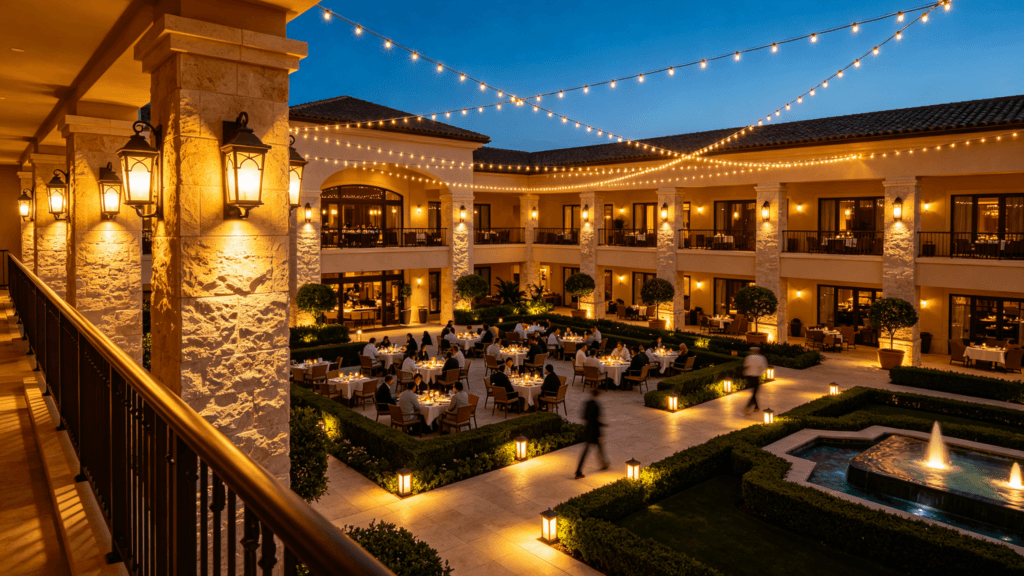
Definition: Commercial outdoor decorative lighting installation is the professional deployment of aesthetic and functional exterior luminaires — including string lights, wall lanterns, post lights, path lights, and architectural accent fixtures — on commercial properties such as hospitality venues, retail plazas, and municipal landscapes. Unlike residential landscape lighting, commercial installations require adherence to NEC electrical safety codes, IES lighting zone standards (RP-43-25), IECC energy conservation mandates, and jurisdiction-specific photometric compliance documentation. This process encompasses site assessment, electrical engineering calculations, fixture mounting, circuit protection, control system integration, and AHJ-approved commissioning.
2. Pre-Installation Planning and Site Assessment
2.1 Site Survey and Load Analysis
Before a single trench is dug or conduit run, the installation team must complete a comprehensive site survey. I’ve learned — sometimes painfully — that what’s on the architectural rendering rarely matches what’s in the ground.
Critical site assessment checklist:
| Assessment Item | Why It Matters | Common Pitfall |
|---|---|---|
| Soil composition and drainage | Affects grounding electrode effectiveness and conduit burial depth | Clay-heavy soil increases resistance; plan for supplemental grounding |
| Existing underground utilities | Prevents service strikes and determines conduit routing | Skipping 811 utility locate = project shutdown + fines |
| Available electrical service capacity | Confirms panel can handle additional load | Commercial outdoor circuits often add 40–80A continuous load |
| Prevailing wind exposure | Determines pole/fixture wind-load ratings required | Coastal and high-rise applications need engineering-stamped mounting |
| Ambient light pollution sensitivity | Dictates BUG rating selection and shielding requirements | Nearly 950 North American municipalities now have lighting ordinances |
A proper load analysis should calculate total connected load (watts), apply NEC demand factors where applicable, and confirm that the existing service panel has at minimum 25% spare capacity for the outdoor branch circuits. I always spec a separate outdoor-rated subpanel when the connected load exceeds 60A — it simplifies troubleshooting and future expansion.
2.2 Permitting and AHJ Coordination
Every commercial outdoor lighting installation requires permits. The Authority Having Jurisdiction (AHJ) will typically require:
- Electrical permit — covers wiring, conduit, panel work
- Building permit — may be required for pole foundations, structural mounting
- Site plan review — showing fixture locations, photometric data, and lighting zone compliance
Pro tip from the field: Schedule a pre-submission meeting with the AHJ when the project involves smart controls, solar-hybrid fixtures, or mounting on historic structures. I’ve saved clients an average of 4–6 weeks in permit review time by getting the inspector’s input before engineering drawings are finalized. The cost of that one-hour meeting is negligible compared to a redesign after plan rejection.
3. Understanding Commercial-Grade Electrical Requirements
This section is where commercial installations diverge most sharply from residential work. If you’re a contractor transitioning from residential landscape lighting to commercial projects, the learning curve is steep but manageable — provided you respect the numbers.
3.1 Voltage Drop: The Silent Performance Killer
In commercial outdoor lighting, long circuit runs are the norm — a retail plaza perimeter can easily span 300–500 linear feet. At those distances, voltage drop becomes the primary threat to consistent light output and fixture longevity.
The rule I enforce on every project: Maximum 3% voltage drop on branch circuits, per NEC 210.19(A) Informational Note No. 4. For outdoor decorative lighting where color temperature consistency matters (hospitality applications are unforgiving here), I tighten this to 2%.
Quotable statistic: "Contractors using #12 AWG for 200-foot LED runs are losing 5–7% voltage at the last fixture — the difference between a crisp 3000K warm white and a dim, amber-shifted disappointment." — Field measurements from commercial installations confirm that voltage drop, not ampacity, is the primary determinant of outdoor lighting performance on runs exceeding 150 feet. NEC ampacity tables alone are necessary but insufficient for specification.
Quick reference — 120V copper conductor sizing for ≤3% voltage drop:
| Circuit Length (ft) | 10A Load | 15A Load | 20A Load |
|---|---|---|---|
| 100′ | #12 AWG | #10 AWG | #10 AWG |
| 200′ | #10 AWG | #8 AWG | #6 AWG |
| 300′ | #8 AWG | #6 AWG | #4 AWG |
| 400′ | #6 AWG | #4 AWG | #3 AWG |
Field observation: I consistently see contractors using #12 AWG for 200-foot LED runs “because the load is only 8 amps.” They’re technically within ampacity limits but losing 5-7% voltage at the last fixture. That’s the difference between a crisp 3000K warm white and a dim, amber-shifted disappointment. Size for voltage drop, not just ampacity.
3.2 NEC 2026: Limited-Energy Systems and GFCI Expansion
The 2026 edition of the National Electrical Code® (NFPA 70®) introduces changes that directly impact commercial outdoor lighting installations. Understanding these updates is no longer optional — most U.S. jurisdictions adopt NEC revisions within 12-18 months of publication.
Quotable insight: "The NEC 2026 replacement of 'low voltage' with 'limited-energy' is more than a terminology change — it reclassifies how Class 2 lighting circuits are documented in permits, panel schedules, and as-built drawings across every U.S. jurisdiction that adopts NFPA 70." — Industry analysis from the National Fire Protection Association (NFPA, 2026) and field reports from early-adopter jurisdictions confirm this documentation shift has already caused permit rejections for contractors unaware of the terminology requirement.
Key NEC 2026 changes affecting outdoor decorative lighting:
- “Limited-Energy” replaces “Low-Voltage” — The NEC has retired the term “low voltage” in favor of “limited-energy” for systems operating below standard utility voltage. This affects how Class 2 low-voltage landscape lighting circuits (typically 12V–24V systems) are classified and documented. While the practical installation requirements haven’t changed dramatically for 12V LED systems, the new terminology must appear in all permit documentation, panel schedules, and as-built drawings — a administrative detail that has already tripped up contractors on several 2026 projects I’ve reviewed. (Source: NFPA / NEC 2026)
- Expanded GFCI requirements — Effective September 1, 2026, GFCI protection is compulsory for outdoor HVAC units, and the same protective philosophy extends to outdoor luminaire circuits in damp and wet locations. All 125V, single-phase, 15A and 20A receptacles installed outdoors now require GFCI protection with no exceptions for dedicated equipment circuits. For lighting installers, this means hardwired outdoor fixtures must either be on GFCI-protected circuits or, where manufacturer instructions permit, use GFCI breakers at the panel. (Source: Schneider Electric NEC 2026 Summary)
- Arc flash labeling expansion — Arc flash warning labels are now required on a broader range of equipment, including outdoor lighting control panels and disconnect switches, regardless of amperage. If your installation includes a dedicated outdoor lighting control panel, factor this labeling requirement into your close-out documentation.
Practical impact: On a typical commercial outdoor lighting project — say a restaurant patio with 30 decorative wall sconces and string lights — these NEC 2026 changes add approximately 2-3 hours to the electrical rough-in and documentation phase. The cost is modest; the liability of non-compliance is not.
3.3 Conductor Types and Wet-Location Requirements
Every conductor installed outdoors for decorative lighting — even inside conduit — must be rated for wet locations. Underground conduit is classified as a wet location per NEC 300.9, and condensation is inevitable regardless of how well you seal the system.
Specify these conductors for outdoor commercial lighting:
- THWN-2 — Minimum requirement for conduit in wet locations; rated 90°C
- XHHW-2 — Preferred for underground and high-temperature environments; superior insulation integrity
- UF-B — Direct burial cable; acceptable for shallow (<24″) landscape circuits where conduit isn’t practical
I standardize on XHHW-2 for all commercial outdoor runs, even inside PVC conduit. The cross-linked polyethylene insulation handles the thermal cycling of outdoor environments — from summer afternoon heat to winter freeze — far better than standard THHN/THWN. The material cost difference is about 15-20%, but I’ve never had an XHHW-2 insulation failure in 15 years of outdoor installations.
4. Lighting Zone Classification and Photometric Planning {#4-lighting-zones}
4.1 IES RP-43-25: The New Outdoor Lighting Standard
In Q2 2026, the Illuminating Engineering Society published ANSI/IES RP-43-25: Recommended Practice for Lighting Exterior Applications, a landmark standard that consolidates the former LP-2 (Designing Quality Lighting) and LP-11 (Environmental Outdoor Lighting) into a single comprehensive document.
Quotable statistic: "With nearly 950 North American municipalities now having lighting ordinances (DesignLights Consortium, 2025), the expanded LUNA QPL provides a practical bridge between policy intent and product specification — contractors who ignore lighting zone requirements are installing into a regulatory environment where non-compliance is increasingly detectable and enforceable."
RP-43-25 defines four lighting zones that now govern virtually every commercial outdoor lighting installation in jurisdictions that reference IES standards:
| Zone | Designation | Typical Applications | Key Restriction |
|---|---|---|---|
| LZ-1 | Dark | National parks, rural areas, astronomical observatories | Very limited uplight; strict curfew controls |
| LZ-2 | Low | Residential suburbs, small-town commercial | Low ambient brightness; limited spill light |
| LZ-3 | Medium | Urban commercial, shopping centers, hospitality | Moderate brightness; BUG-rated fixtures required |
| LZ-4 | High | Dense urban cores, entertainment districts | Higher brightness permitted; still subject to curfew reductions |
The new standard also introduces updated glare metrics, color considerations (particularly relevant for decorative lighting where warm CCTs are the aesthetic norm), and expanded controls guidance. If your project falls under a jurisdiction that has adopted RP-43-25 — and I expect the majority of U.S. municipalities to reference it within 24 months — your photometric plan must demonstrate zone-level compliance. (Source: IES Standards)
4.2 BUG Ratings and TM-15-20 Compliance
The BUG rating system (Backlight, Uplight, Glare), defined by ANSI/IES TM-15-20, has moved from recommended practice to regulatory requirement in many jurisdictions. Under California’s 2025 Non-Residential Energy Regulations, all outdoor luminaires of 6,200 lumens or more must comply with BUG requirements — with limited exceptions for facades, monuments, and public art.
For outdoor decorative lighting installation, this means:
- Wall-mounted decorative sconces must be selected with attention to backlight ratings — light trespass into neighboring properties is the most common source of post-installation complaints
- String lights and festoon lighting generally fall below the 6,200-lumen threshold per fixture, but cumulative output across a commercial installation often triggers BUG review at the site-plan level
- Uplight ratings are especially critical for landscape uplighting of trees and architectural features — decorative lighting that casts significant upward light may be restricted in LZ-1 and LZ-2 zones
4.3 Photometric Plan Requirements
A professional-grade outdoor decorative lighting installation requires a photometric plan — a computer-modeled lighting calculation that demonstrates illuminance levels, uniformity ratios, and BUG compliance across the site.
Minimum deliverables for AHJ submission:
- Point-by-point illuminance grid (foot-candles) at grade level
- Average-to-minimum uniformity ratio (target 4:1 or better for pedestrian areas)
- Maximum-to-minimum uniformity ratio for safety-critical paths (target 10:1 or better)
- BUG rating summary for each fixture type
- Lighting zone designation and compliance statement
Software like AGi32, DIALux evo, or Visual Lighting is standard. I recommend having a certified lighting designer (LC) review and stamp the photometric plan for projects exceeding $50,000 in fixture value — the stamped document carries significantly more weight with AHJs and eliminates plan-review delays.
5. Fixture Selection and Mounting Standards {#5-fixture-selection}
5.1 IP Rating Requirements by Installation Environment
| Installation Location | Minimum IP Rating | Recommended | Rationale |
|---|---|---|---|
| Under eave / covered ceiling | IP44 | IP65 | Protected from direct rain; splash resistance sufficient |
| Wall-mounted, exposed | IP65 | IP66 | Direct rain exposure and wind-driven moisture |
| In-ground / grade-level | IP67 | IP68 | Temporary submersion during heavy rain or irrigation |
| Coastal / marine environment | IP66 + 316 stainless | IP68 + marine-grade | Salt spray corrosion; IP rating alone insufficient |
A common mistake I see is specifying IP65 fixtures for in-ground applications “because the spec sheet says waterproof.” IP65 protects against water jets, not submersion — and a recessed ground light in heavy clay soil will sit in standing water after every thunderstorm. That’s IP67 territory, minimum.
5.2 Mounting Heights and Structural Requirements
Commercial outdoor decorative lighting fixtures are subject to wind loading, impact risk, and in some regions, seismic requirements. Mounting specifications should be engineering-reviewed when:
- Poles exceed 15 feet in height
- Fixtures weigh more than 50 lbs
- Installation is in a high-wind zone (≥110 mph design wind speed per ASCE 7)
- The structure is rated Seismic Design Category D or higher
For wall-mounted decorative fixtures on commercial buildings, I specify minimum 1/4″ stainless steel toggle bolts or sleeve anchors into structural substrate — never into siding or EIFS alone. A 20-pound wall lantern in a 90-mph wind gust generates enough lever force to pull standard screws out of sheathing.
5.3 Sourcing Quality Fixtures
Fixture quality begins with supplier selection. For B2B buyers importing fixtures for commercial installation projects, our guide on how to find reliable outdoor lighting suppliers in China covers factory verification, certification requirements, and quality control protocols that directly impact installation reliability.
Critical pre-installation verification: Before mounting any fixture from a new supplier, verify that the certification documentation matches what the manufacturer claimed during procurement. Our manufacturer certification verification framework specifies exactly which documents to request — ISO 9001:2015 certificates, CE/UL/ETL test reports, IP rating test certificates, and LM-79/LM-80 photometric reports. Cross-reference these against the fixture’s nameplate data before the first unit goes on the wall. A fixture that fails six months after installation costs far more in warranty labor than any upfront savings on unit price.

6. Wiring, Grounding, and Circuit Protection {#6-wiring-grounding}
6.1 Grounding Requirements for Outdoor Circuits
Outdoor lighting circuits demand more rigorous grounding than indoor equivalents. The combination of moisture, soil conductivity, and public accessibility creates conditions where ground-fault protection is not just code-compliant — it’s life-safety critical.
Commercial outdoor grounding protocol:
- Equipment grounding conductor (EGC) — Sized per NEC 250.122 with the circuit’s overcurrent device. Run with all circuit conductors in the same conduit or cable.
- Ground rod at remote structures — Any pole or structure more than 50 feet from the main building requires a supplemental grounding electrode (typically an 8-foot ground rod) bonded to the EGC per NEC 250.32.
- Bonding of metallic poles and housings — All metal lighting poles, bollards, and fixture housings must be bonded to the EGC. I use a #8 AWG solid copper bonding jumper with a listed direct-burial ground clamp at each pole.
- GFCI protection — Per NEC 2026 expanded requirements, outdoor lighting circuits serving receptacles or accessible fixtures must be GFCI-protected. I standardize on GFCI breakers at the panel rather than individual receptacle GFCIs — they’re less susceptible to moisture-related nuisance tripping and simplify troubleshooting.
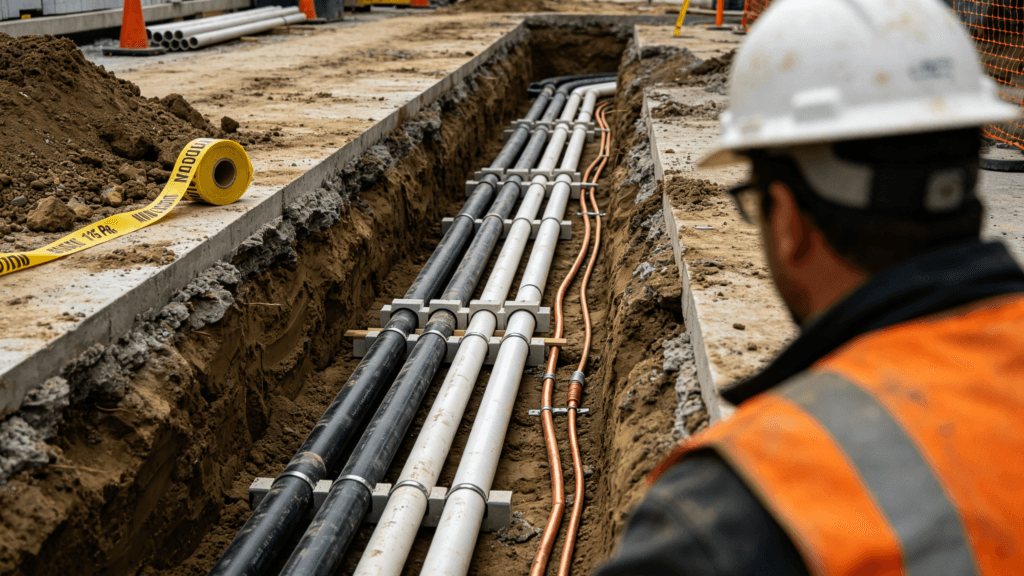
6.2 Conduit Selection and Burial Depth
| Conduit Type | Minimum Burial Depth | Best Application |
|---|---|---|
| Rigid Metal Conduit (RMC) | 6″ | High-traffic areas, under roadways |
| Intermediate Metal Conduit (IMC) | 6″ | Commercial parking lots, loading zones |
| Schedule 80 PVC | 18″ | Standard commercial landscape runs |
| Schedule 40 PVC | 18″ | Low-traffic landscape areas only |
| HDPE (continuous) | 18″ | Long, straight runs with minimal bends |
I specify Schedule 80 PVC as the minimum for all commercial outdoor work. The cost difference versus Schedule 40 is roughly 30%, but the impact resistance — think landscape maintenance equipment, vehicle traffic, and freeze-thaw ground movement — justifies it every time. For runs under parking lots or driveways, RMC is non-negotiable.
6.3 Junction Box and Splice Requirements
Every outdoor electrical splice must be in a listed, weatherproof junction box with the NEMA rating appropriate for the location. Accessible handholes at pole bases should be NEMA 3R minimum. For in-ground junction boxes in landscape beds, I specify NEMA 6P (submersible) with poured epoxy splices — it’s overkill by most interpretations, but I’ve never had to dig one up twice.
7. Control Systems and Energy Code Compliance
7.1 IECC 2024 Mandatory Controls
The 2024 International Energy Conservation Code (IECC) — already adopted by multiple states — mandates specific control requirements for commercial exterior lighting:
- Automatic shutoff — All exterior lighting must be controlled by a photosensor or astronomical time switch that automatically turns off lighting during daylight hours
- Scheduling — Lighting must be capable of being reduced by at least 50% during non-business hours through scheduled dimming or partial shutoff
- Motion sensing for specific applications — Parking areas, walkways less than 30 feet wide, and building entrances require occupancy-based reduction controls
The U.S. Department of Energy’s Better Buildings Initiative provides exterior lighting control guidance that walks through compliant control sequences. I reference this document in every commercial project specification — it’s been invaluable for explaining control requirements to clients who balk at the upfront cost of networked systems.
7.2 Control System Architecture for Commercial Outdoor Decorative Lighting
Recommended architecture for a mid-scale commercial installation (20-60 fixtures):
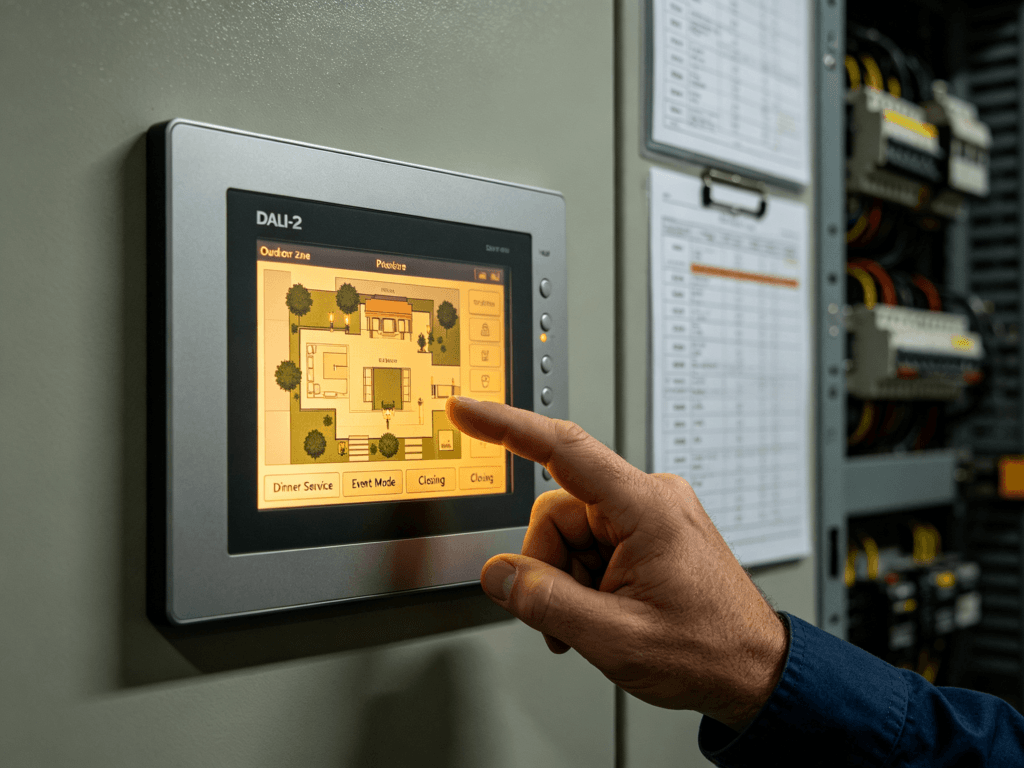
- Control protocol: DALI-2 or 0-10V dimming (DALI-2 preferred for addressable fixture-level control)
- Central controller: Networked lighting control panel with astronomical time clock, photocell input, and BACnet/IP integration for BAS connectivity
- Zone sensors: Combination photocell + occupancy sensors, one per lighting zone
- Override interface: Touchscreen or keypad at facility manager’s office; smartphone app access for after-hours events
Pro tip: When installing decorative lighting for hospitality venues — restaurants, hotels, event spaces — include a “scene recall” function that lets staff switch between pre-programmed lighting scenes (dinner service, event setup, closing/cleaning) without touching the programming interface. It’s a $200-400 addition to the controls budget that clients rave about in post-project reviews.
7.3 Demand Response and Title 24 Compliance
California’s Title 24-2025 and similar state-level codes now require demand-responsive lighting controls for certain commercial applications. In practice, this means the lighting control system must be capable of receiving and responding to demand response signals — typically a 15% reduction in lighting load during grid peak events.
For outdoor decorative lighting installations in California, Arizona, and increasingly other states, the control system specification should include:
- OpenADR 2.0b compliance or BACnet gateway connection to building automation
- Documented demand response sequence in the control narrative
- Verification testing report in commissioning documentation
The DesignLights Consortium (DLC) maintains the Networked Lighting Controls Qualified Products List — selecting DLC-listed control systems can also qualify the project for utility rebates, often offsetting 30-50% of controls hardware cost.
8. Inspection, Commissioning, and Documentation
8.1 Pre-Inspection Checklist
Before calling the AHJ for final inspection, verify these items — I’ve used this checklist on over 200 commercial projects:
- GFCI devices trip and reset correctly (test at each device, not just at the panel)
- All junction boxes are accessible and have weatherproof covers with gaskets intact
- Conduit connections are wrench-tight; expansion joints installed where runs exceed 100 feet
- Pole bases are plumb, handhole covers secured, and warning labels visible
- Photometric measurements taken at 5 representative points and within 15% of design values
- Control system demonstrates: automatic on/off at specified lux levels, manual override, and scheduled dimming
- Panel directory is updated and accurate — handwritten amendments are fine, but they must be legible
- Arc flash labels affixed to outdoor lighting control panels (NEC 2026 requirement)
8.2 Commissioning: The Step Most Contractors Skip
Commissioning is distinct from inspection. Inspection confirms code compliance; commissioning confirms design performance. On commercial outdoor decorative lighting projects, commissioning should include:
- Night-time photometric verification — Walk the site 2 hours after sunset; measure foot-candles at key points; compare to design values
- Control sequence validation — Document each control mode: occupied, unoccupied, curfew, manual override, demand response
- Color temperature and CRI verification — Critical for hospitality jobs; I use a handheld spectrometer (Sekonic C-800 or similar) to verify CCT and CRI at installation — the reading at the fixture face is your benchmark for warranty claims if performance degrades
- Thermal imaging scan — A $300 thermal camera pays for itself on the first project. Scan each fixture, junction box, and panel connection after 2 hours of continuous operation. Any connection running more than 15°F above ambient gets flagged for re-torque.
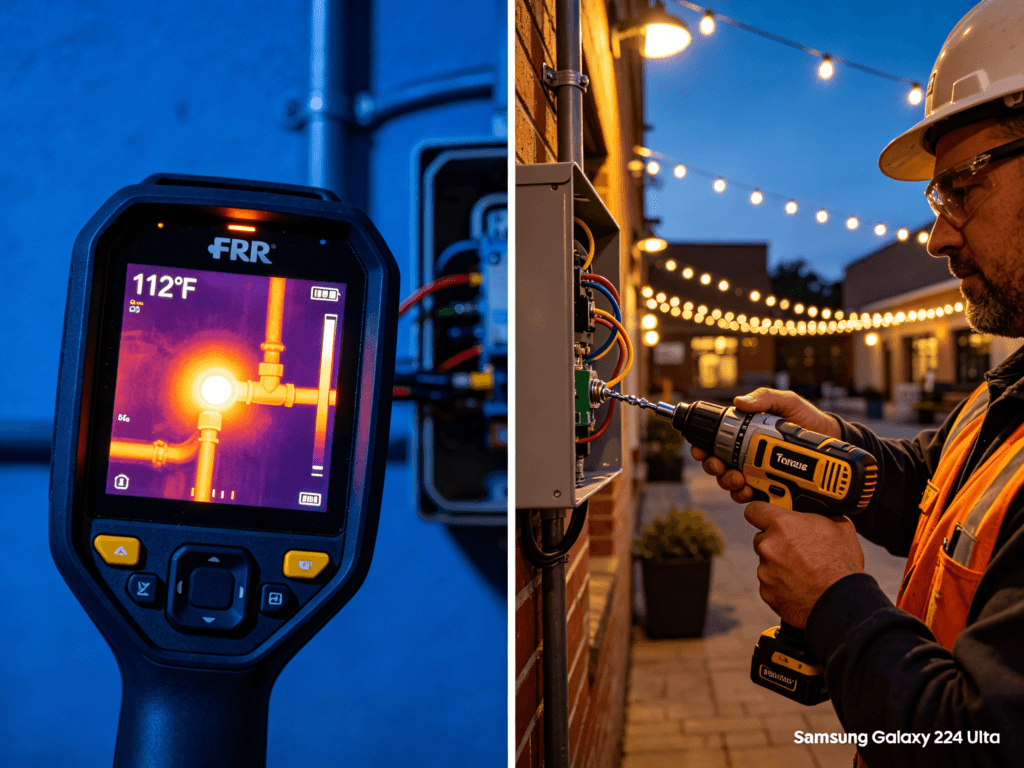
Debug Thermal Imaging Scan – Thermal imaging of an outdoor lighting junction box shows an abnormal temperature at one connection point (112°F / 86°F ambient) and needs to be retightened.
8.3 As-Built Documentation
Your as-built package should include:
- Single-line diagram of outdoor lighting circuits with conductor sizes and circuit numbers
- Fixture schedule with make, model, and serial numbers (photograph each serial number plate)
- Photometric as-built report
- Control system programming guide and admin credentials
- Maintenance schedule and recommended spare parts list
Store these digitally and provide both the property owner and facility manager with copies. I also recommend keeping an offline copy — I’ve been called back to projects 5 years later where the facility manager had changed three times and no one knew where the lighting panel was, let alone how to reprogram the controls.
9. Maintenance Protocols for Commercial Installations
9.1 Scheduled Maintenance Intervals
| Interval | Task | Responsible Party |
|---|---|---|
| Monthly | Visual inspection of all visible fixtures; note any dark or flickering units | Facility staff |
| Quarterly | Clean lenses and diffusers; check for water ingress in fixture housings | Facility or contractor |
| Semi-annually | Inspect all accessible junction boxes and handholes for water, corrosion, or pest intrusion | Licensed electrician |
| Annually | Full system inspection: torque check connections, thermal scan, GFCI test, control system battery replacement | Licensed electrician |
| Every 5 years | Re-lamp (if non-LED), gasket replacement on all weatherproof enclosures, re-commissioning | Lighting contractor |
9.2 Troubleshooting Common Commercial Outdoor Issues
- Flickering LED fixtures: Check for loose neutral connections first — 80% of the flicker I troubleshoot traces to a shared neutral with a compromised splice in a junction box. Then verify dimmer compatibility; not all LED drivers handle phase-cut dimming cleanly.
- GFCI nuisance tripping: Moisture in junction boxes is the top culprit. Replace standard gaskets with silicone equivalents and add desiccant packs in NEMA 3R enclosures. If tripping persists, verify cumulative leakage current across all fixtures doesn’t exceed 4mA.
- Premature LED failure: Failed LEDs in under 10,000 hours almost always trace to thermal management issues — either the fixture isn’t rated for the ambient temperature, or the driver compartment lacks adequate ventilation. Check the manufacturer’s maximum ambient temperature rating against your installation environment. Our weather resistance and certification guide provides a deeper framework for matching IP ratings and material specifications to real-world installation conditions.
10. FAQ
What certifications should a commercial outdoor lighting installer hold?
A licensed electrical contractor credential for the project jurisdiction is the baseline requirement. Additionally, NICET certification in electrical power testing is recommended for systems exceeding 600V, and the NALMCO Certified Lighting Management Consultant (CLMC) credential demonstrates competency in commercial lighting systems. At least one team member should hold or have access to a certified lighting designer (LC by NCQLP) for photometric plan review on projects exceeding 50 fixtures. For lighting-specific credentials, the NALMCO Certified Lighting Management Consultant (CLMC) designation demonstrates competency in commercial lighting systems. Additionally, installer staff should include at least one certified lighting designer (LC by NCQLP) or have access to one for photometric plan review on projects exceeding 50 fixtures.
How do I determine the right IP rating for a coastal installation?
Specify IP66 minimum for exposed fixtures and IP68 for in-grade applications, with marine-grade 316 stainless steel hardware — standard 304 stainless develops pitting corrosion within 12-18 months in salt-spray environments. Bronze alloys such as architectural bronze (C38500) offer superior natural corrosion resistance versus standard brass. For installations within 3 miles of salt water, IP rating alone is insufficient — material composition determines long-term durability.
What is the difference between NEC and IECC requirements for outdoor lighting?
The NEC (NFPA 70) governs electrical installation safety — wiring methods, circuit protection, and grounding. The IECC governs energy efficiency — lighting power density limits, mandatory automatic shutoff, and dimming requirements. A compliant installation must satisfy both simultaneously: NEC defines how to install safely, IECC defines how to operate efficiently. They address different regulatory domains and a project can pass one inspection while failing the other.
How long should a commercial outdoor lighting installation take?
A mid-scale project (30-50 decorative fixtures, networked controls) typically requires 5-8 working days of on-site electrical labor with a 2-person crew, plus 1-2 days for commissioning and documentation. Pole foundations or trenching add 2-3 days; complex control programming or historic structure work extends timelines to 3-4 weeks. Always include a minimum 3-day buffer before the AHJ inspection date to handle punch-list items.
Are solar-powered decorative lights viable for commercial installations?
Solar fixtures work best as accent/ambient lighting in LZ-1 and LZ-2 zones with reliable sun exposure — not as primary commercial illumination. The DLC’s LUNA V2.0 Technical Requirements (2025) expanded eligibility for solar luminaires, but real-world limitations persist: winter output drops significantly in northern latitudes, batteries require replacement at years 3-5, and urban shading degrades performance. When specifying solar, always require a manufacturer-provided solar insolation analysis and derate published lumen output by 30% for planning purposes.
11. Conclusion
A professional-grade outdoor decorative lighting installation is the difference between a project that looks right and one that is right — code-compliant, energy-efficient, maintainable, and safe for the decade-plus lifespan expected of commercial infrastructure.
The landscape is shifting: NEC 2026 redefines the terminology and safety requirements for limited-energy lighting systems. IES RP-43-25 establishes a unified framework for exterior lighting quality across all four lighting zones. The IECC 2024 mandates control capabilities that were optional upgrades just one code cycle ago. Staying current isn’t a marketing advantage — it’s the baseline for competent commercial work.
Next steps for your project:
- Review your existing site against the lighting zone classification — if you’re in LZ-2 or LZ-3, your fixture selection and photometric documentation need to prove compliance
- Audit your control systems against IECC 2024 mandatory provisions — if you’re still installing simple photocell-only controls, you’re likely non-compliant in adopted jurisdictions
- Verify your grounding and GFCI protocols against NEC 2026 expanded requirements — these changes carry the highest liability risk
For buyers sourcing fixtures for upcoming installation projects, the foundation of a trouble-free installation is a reliable supply chain. Our pillar guide on sourcing outdoor decorative lighting from China walks through supplier verification, quality control, and logistics — paired with our guide to outdoor lighting trade shows for in-person supplier vetting at events like the Canton Fair.
If you’re specifying for a specific commercial application — hospitality, retail, municipal — reach out to discuss the electrical and photometric requirements. An hour of upfront planning avoids weeks of post-installation remediation.