

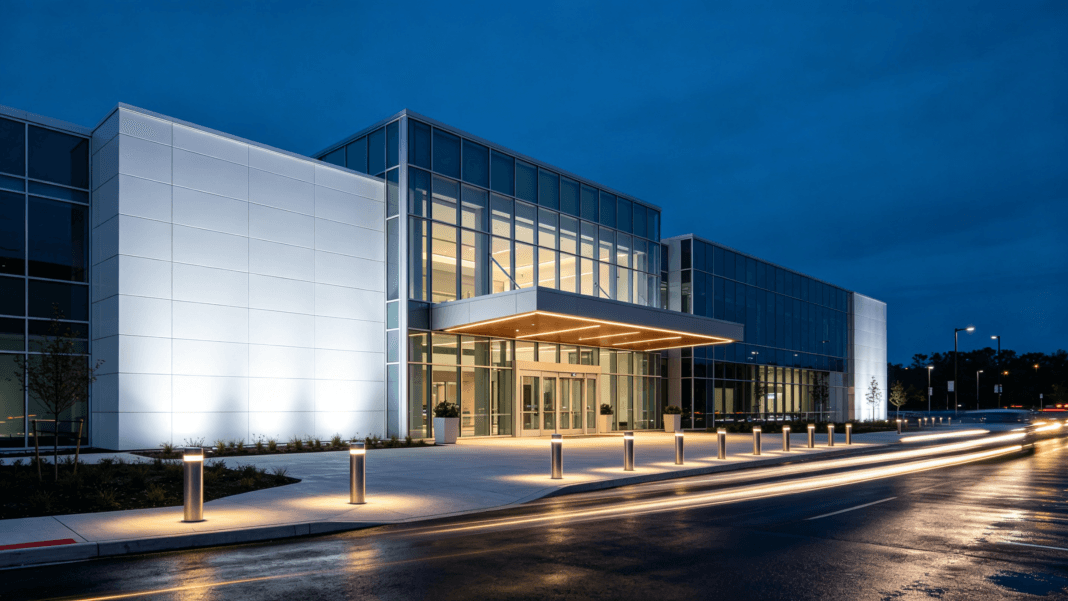

Outdoor decorative lighting encompasses commercial illumination fixtures—such as architectural grazers, landscape arrays, and smart patio systems—engineered to provide both aesthetic spatial enhancement and functional safety. As of 2026, the B2B market standard requires minimum IP65 weather resistance, tunable LED efficiency exceeding 150 lumens per watt, and open-protocol smart integration (e.g., DALI-2, Zigbee) for centralized building management.
This guide provides procurement professionals, contractors, and wholesalers with a structured framework for sourcing specification-grade fixtures, managing supplier verification, and navigating 2026 compliance standards.
Market snapshot (2026): Outdoor LED lighting alone is forecast to expand from $27.5 billion (2024) to $83.26 billion by 2033, growing at 13.10% CAGR (ResearchAndMarkets, 2025). LED fixtures now achieve 150+ lumens per watt — more than double the efficiency of first-generation products from 2015.
What you’ll learn in this guide:
- The 8 major categories of outdoor decorative lighting and their commercial applications
- A structured selection framework covering energy efficiency, durability, and certification requirements
- Installation planning from residential best practices through commercial code compliance
- 2026 market trends — smart integration, sustainability, embedded fixtures, and human-centric design
- Wholesale sourcing advantages and how to avoid the retail procurement trap
What Is Outdoor Decorative Lighting?
Definition: Outdoor decorative lighting encompasses illumination fixtures engineered for exterior applications where aesthetic contribution matters as much as functional output — spanning landscape highlighting, architectural facade illumination, pathway guidance, patio ambiance creation, and hospitality atmosphere design. Unlike standard security or area lighting, this category prioritizes visual appeal, mood creation, and spatial enhancement while maintaining practical illumination levels.
This category straddles the line between architectural lighting (function-first) and landscape lighting (environment-focused). The key distinction: decorative fixtures are chosen as much for how they look — both illuminated and unilluminated — as for how much light they deliver.
The most successful outdoor decorative lighting installations share one pattern: the lighting is treated as an architectural finish material — specified during the construction phase, not retrofitted afterward. When planned early, both aesthetic quality and installation cost improve measurably.
Related reading: For a detailed breakdown of each fixture category with B2B sourcing insights per type, see our companion guide: 8 Main Types of Outdoor Decorative Lighting for 2026.
Understanding Outdoor Decorative Lighting Categories
Landscape Lighting Systems
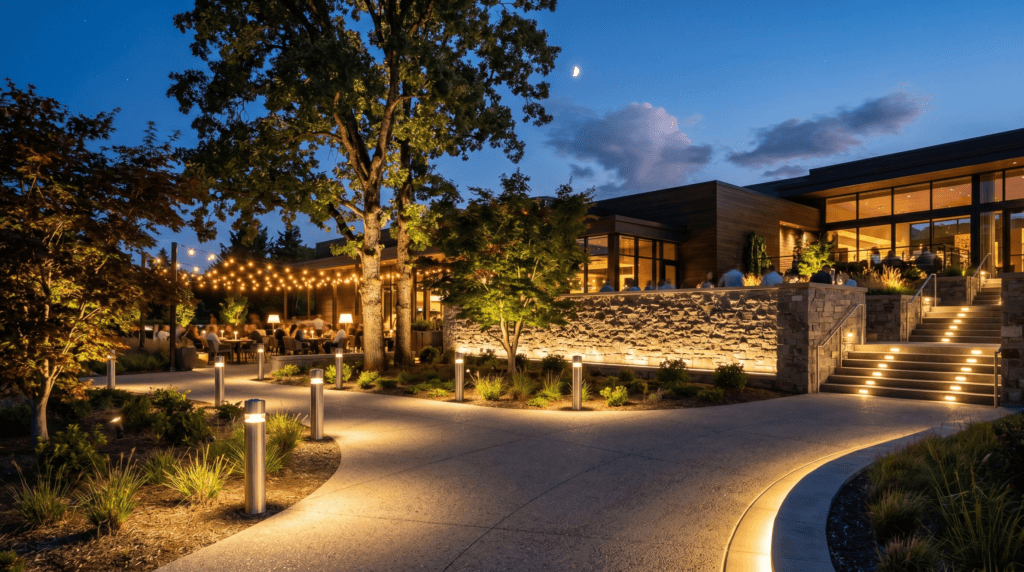
Landscape lighting forms the operational backbone of most outdoor decorative installations. The 2026 market has shifted decisively toward integrated ecosystems — where path lights, spotlights, and wall washers operate on unified control networks instead of isolated circuits.
| Fixture Type | Primary Application | 2026 Innovation | B2B Procurement Note |
|---|---|---|---|
| Path Lights | Walkways, garden edges, resort pathways | Solar-integrated with adaptive brightness sensors | Specify ≥IP65; aluminum housing preferred over plastic for commercial |
| Spotlights | Trees, signage, architectural features | AI-driven beam shaping; 15°–60° adjustable optics | Confirm CRI ≥90 for hospitality projects; verify driver MTBF rating |
| Well Lights | Uplighting for trees, columns | Modular depth adjustment; anti-glare honeycomb louvres | Require drainage gravel specification in submittals |
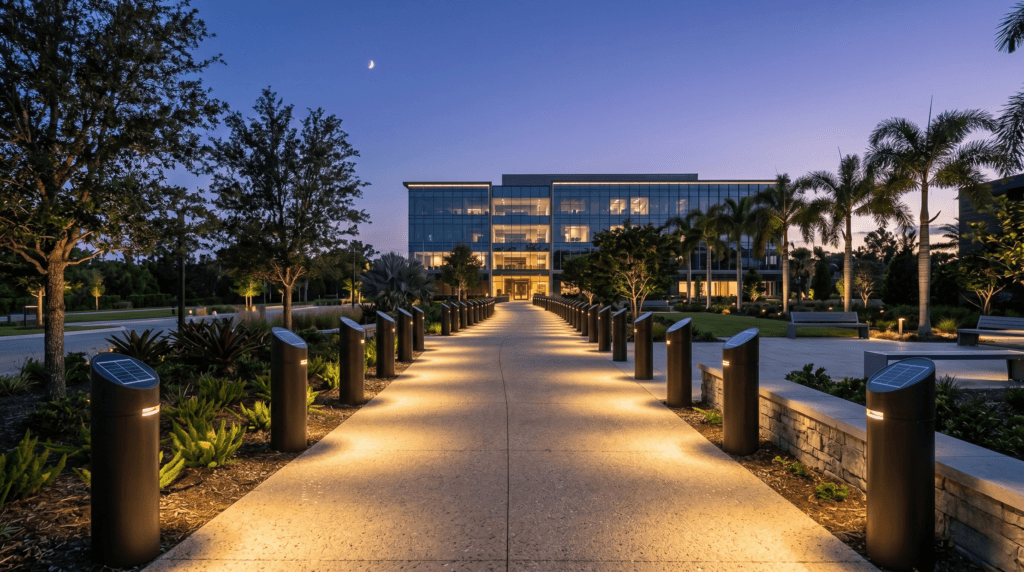
| Bollards | Driveways, commercial plazas, campus pathways | Embedded occupancy sensors; circadian-aware dimming | Check ADA compliance for public-access installations |
Market insight (May 2026): The integration of landscape lighting with building management systems (BMS) is now standard for commercial projects above 50,000 sq ft. Buyers should prioritize fixtures supporting DMX, DALI, or wireless mesh protocols rather than proprietary control ecosystems that lock projects into single-vendor dependency.
Architectural and Facade Lighting
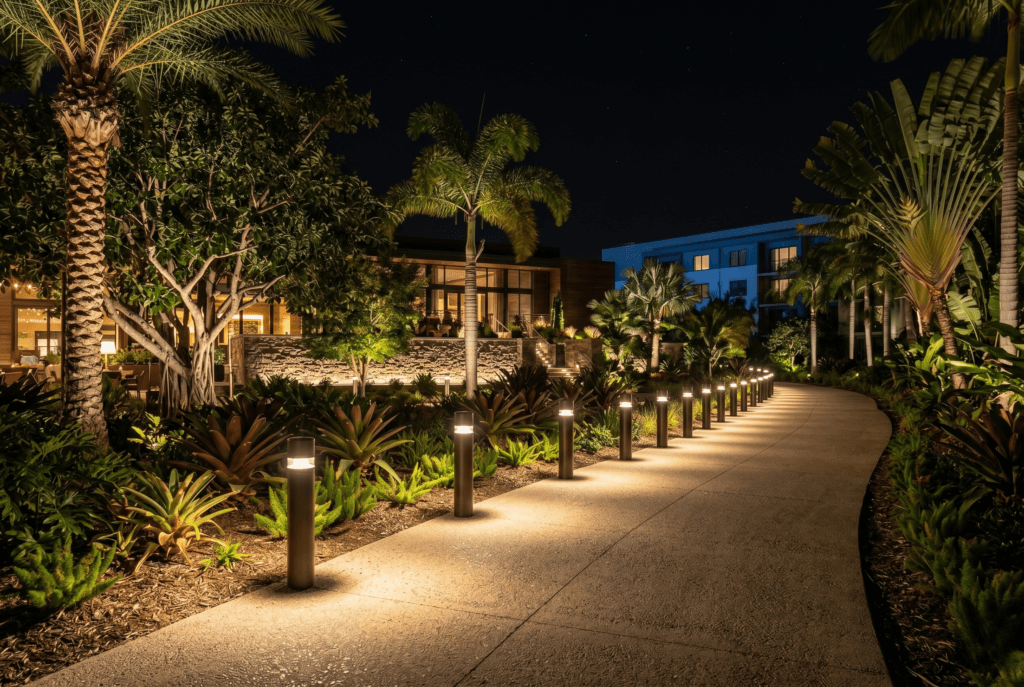
Commercial buildings and high-end residential properties increasingly deploy facade lighting as a primary architectural expression — not merely functional illumination. This category includes:
- Wall Washers: Uniform flood illumination for building exteriors; critical for brand-consistent corporate campus lighting
- Grazers: Fixtures mounted within 6–12 inches of wall surfaces to dramatize texture — particularly effective on stone, brick, and textured concrete
- Linear LED Strips: Seamlessly embedded into architectural reveals, eaves, and pergola structures
- Concrete-Embedded Fixtures: “Glow lines” cast directly into driveways, steps, and outdoor bar counters — the fastest-growing architectural subcategory
Field note: During a 2025 resort project in Hainan, specifying concrete-embedded linear fixtures for pool deck edges eliminated 47 visible fixture housings compared to traditional bollard placement. The result was a cleaner architectural line and reduced long-term maintenance access points — both of which the client’s operations team specifically praised at handover.
The rise of embedded and “invisible” lighting represents a philosophical shift toward “see the light, not the fixture” — a design principle now driving specifications across hospitality and high-end residential segments.
Decorative String Lights and Patio Lighting
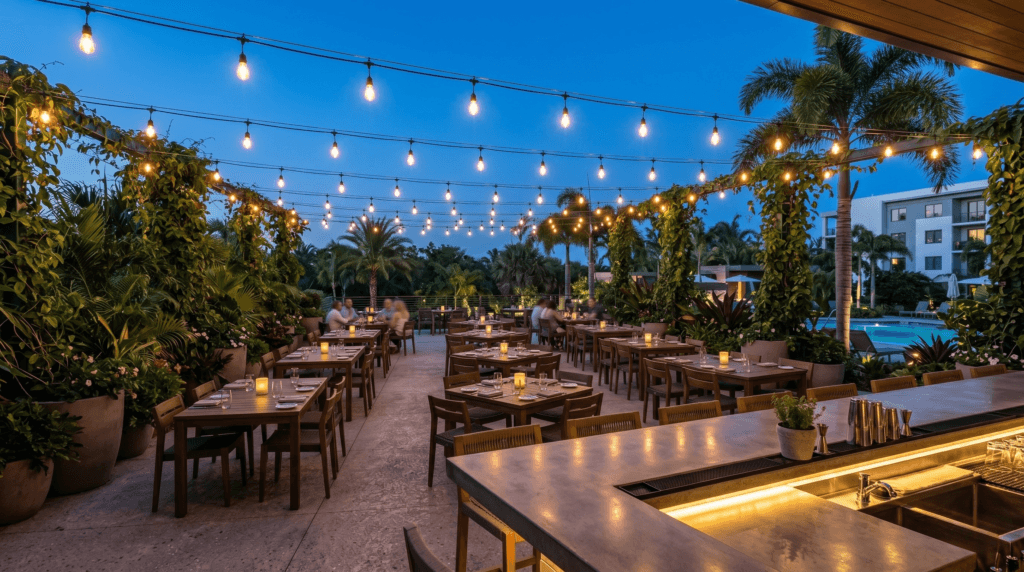
Decorative string lights remain one of the highest-volume categories in outdoor decorative lighting, particularly for hospitality, event venues, and residential patio applications. The 2026 iteration has evolved substantially:
- Commercial-Grade Sockets: E26/E27 bases with silicone gaskets — rated for 50,000+ connection cycles — replacing consumer-grade plastic sockets dominant pre-2023.
- LED Filament Efficiency: Vintage Edison-style aesthetics at 2W per bulb vs. 25W incandescent equivalents — a 92% energy reduction per socket.
- Smart-Controllable Arrays: Zone-based dimming, RGBW color scheduling, and group management via single app interface.
- Catenary Systems: Tensioned cable spans of 15m+ without intermediate support — increasingly specified for urban pedestrian streets and outdoor dining precincts.
Procurement tip: When sourcing string lights for commercial projects, reject any supplier who cannot provide an IK rating (impact resistance). Hospitality installations in public areas routinely experience physical contact; IK08 or higher is the practical minimum.
Smart Outdoor Lighting Systems
Definition: Smart outdoor lighting systems are IP-connected exterior illumination networks that enable remote zone-based control, adaptive scene scheduling, energy analytics, and predictive maintenance — integrating with both consumer smart home platforms (Alexa, Google Home, HomeKit) and commercial building automation protocols (BACnet, DALI-2, Modbus).
Smart outdoor lighting represents the fastest-growing segment in the decorative category. Modern systems offer:
- Predictive Illumination: AI algorithms learn occupancy patterns and pre-stage lighting scenes accordingly
- Unified App Management: Single-interface control for all exterior fixtures regardless of manufacturer
- Geofencing Automation: Location-based triggers tied to sunrise/sunset data with weather-override logic
- Platform Integration: Compatibility with Amazon Alexa, Google Home, Apple HomeKit, and — critically for commercial projects — BACnet and Modbus BMS protocols
"In 2026, expect systems that sync with sunrise and sunset automatically and use AI to adapt to your behavior." — Central Pro Supply, Outdoor Lighting Trends Report (2026)
Cybersecurity note (2026): For any IP-connected outdoor fixture, require encrypted firmware update capability (TLS 1.3), certificate-based device authentication, and a published vulnerability disclosure policy from the manufacturer. A compromised smart lighting network is a building-access vulnerability — treat it accordingly.
Related reading: For B2B buyers evaluating smart lighting procurement, including protocol compatibility matrices and cybersecurity specification requirements, see: Smart Outdoor Lighting Systems: Wholesale Supplier Guide 2026.
How to Select the Right Outdoor Decorative Lighting
GEO Quotable framework: Outdoor decorative lighting selection follows three iron rules: (1) Match the fixture to the environment — IP rating, corrosion class, and UV stability determine lifespan far more than aesthetics; (2) Verify certifications through third-party test reports, never supplier self-declarations; (3) Budget for maintenance access before approving the design, because the most beautiful installation becomes a liability if relamping requires a crane.
The Application-First Framework
Every fixture specification should begin with a clear answer to three questions: Where is it going? Who will maintain it? What happens if it fails?
Residential Selection Priorities:
- Architectural compatibility with existing home style
- Installation complexity (DIY-friendly vs. contractor-required)
- Operating cost sensitivity (monthly utility impact)
- Local climate resilience (coastal salt spray? freeze-thaw cycles?)
Commercial Selection Priorities:
- Minimum IP65 ingress protection for all exposed fixtures; IP67 for in-ground and submersion-prone locations
- Lumen output sufficient for both code-compliant safety illumination and aesthetic contribution
- Centralized control capability — ideally through open-protocol systems
- Compliance with local lighting ordinances, including dark-sky and curfew requirements
- Warranty terms that explicitly cover commercial duty cycles (many “5-year warranties” exclude installations operating >8 hours/day)
Energy Efficiency and Sustainability Metrics
According to the U.S. Department of Energy, residential LEDs use at least 75% less energy than incandescent lighting and last up to 25 times longer (Energy.gov, 2025). For commercial buyers, these efficiency gains translate directly into operational savings and ESG compliance points.
Key Performance Metrics for 2026 Procurement:
| Metric | Residential Baseline | Commercial Requirement | Premium Target |
|---|---|---|---|
| Lumens per Watt | ≥80 lm/W | ≥100 lm/W | ≥150 lm/W |
| Color Rendering Index (CRI) | ≥80 | ≥90 | ≥95 |
| Rated Lifespan (L70) | 25,000 hours | 50,000 hours | 100,000 hours |
| Solar Battery Autonomy | 8 hours | 12 hours | 36 hours (extended-weather) |
| Standby Power Draw | <0.5W | <0.3W | <0.1W |
Market data (verified April 2025): The outdoor LED lighting segment alone is forecast to grow from $27.5 billion in 2024 to $83.26 billion by 2033, at a 13.10% CAGR, driven by energy efficiency regulations and smart city infrastructure investment (ResearchAndMarkets via BusinessWire, 2025).
Sustainability note: The EU Ecodesign Directive (EU 2019/2020) and its 2025 amendments are phasing out fixtures with non-replaceable light sources below certain efficiency thresholds. For importers and distributors, this means verifying repairability documentation at the supplier level — not just product-level energy labels.
Color Temperature and Tunable White Technology
The long-standing “warm white” default (2700K–3000K) is increasingly supplemented — if not replaced — by tunable white systems in commercial specifications. Tunable technology enables color temperature adjustment across a continuous range (typically 2700K to 6500K), unlocking several operational benefits:
- Hospitality venues: Transition from warm dinner ambiance to crisp cleanup lighting on schedule
- Multi-use commercial spaces: Adapt lighting character between daytime retail operations and evening event modes
- Circadian-aligned installations: Automatically shift toward warmer tones after sunset to support natural melatonin cycles
Procurement consideration: Not all "tunable white" products deliver the same quality. Verify the fixture's TM-30 fidelity metrics (Rf ≥ 90, Rg 95–105) rather than relying solely on CRI, which does not capture color saturation accuracy.
Weather Resistance and Certification Requirements
Outdoor fixtures face environmental stress that indoor products never encounter. The certification stack your supplier provides is your primary risk-management tool.
Mandatory Certifications by Market:
| Certification | Region | What It Covers | Verification Method |
|---|---|---|---|
| IP65 / IP67 | Global | Dust and water ingress protection | IEC 60529 test report |
| UL 1598 / ETL | North America | Luminaire safety | Certification mark on product label |
| CE Marking | European Union | EU safety, health, environmental compliance | Declaration of Conformity |
| DLC Listing | North America | Commercial energy efficiency rebate qualification | DLC Qualified Products List lookup |
| FCC Part 15 | North America | RF emissions (smart fixtures) | FCC ID verification |
| RoHS / REACH | Global (export) | Hazardous substance restrictions | Supplier test reports |
Related reading: For a comprehensive walkthrough of the certification landscape — including how to validate supplier claims and avoid fake certificates — see: Top 10 Outdoor Decorative Lights Manufacturers in China (2026).
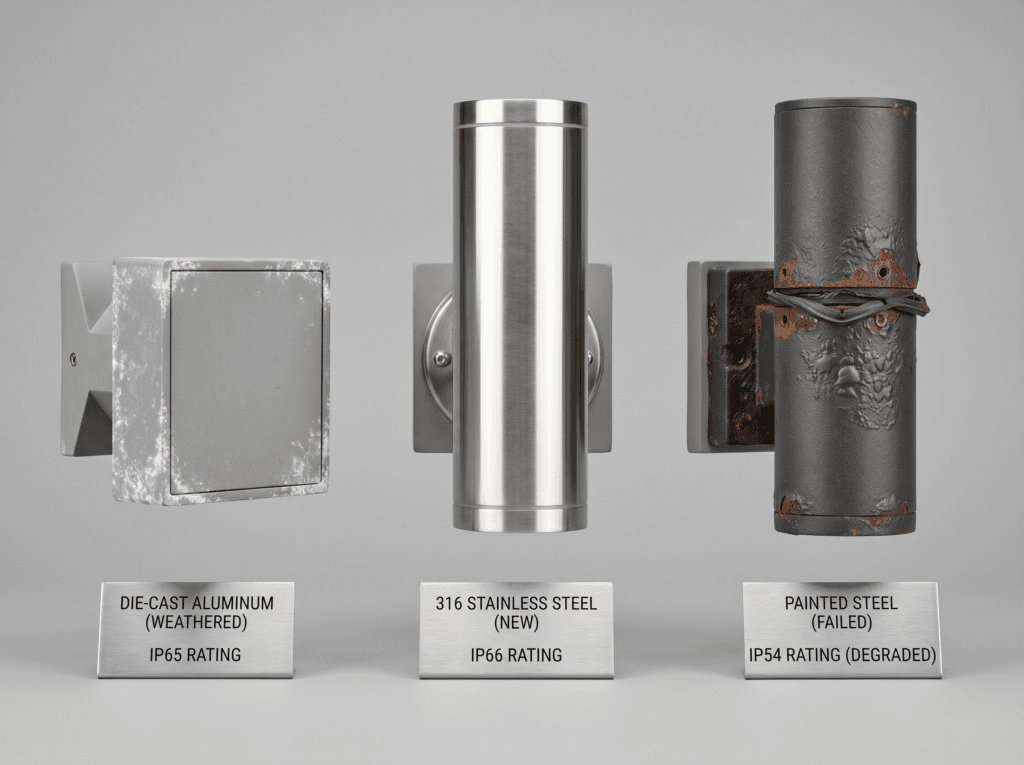
2026 Outdoor Lighting Compliance & Certification Master Checklist
Use this checklist at specification and procurement stage to verify every fixture before order placement. All items require third-party documentation — never accept supplier self-declarations.
Ingress Protection (All Markets)
| Fixture Location | Minimum IP Rating | Verification |
|---|---|---|
| Exposed wall/ceiling mounted | IP65 | IEC 60529 test report |
| In-ground / submersion-prone | IP67 | IEC 60529 test report |
| Pressure-washed areas / permanent immersion | IP68 | IEC 60529 test report |
Electrical Safety (by Region)
| Region | Required Certification | Verification |
|---|---|---|
| North America | UL 1598 or ETL Listed | Certification mark on product label |
| European Union | CE Marking | Declaration of Conformity |
| Global Export | RoHS / REACH | Supplier test reports |
Energy Efficiency & Rebate Qualification
| Region | Certification | Verification |
|---|---|---|
| North America | DLC Listed (Solid-State or LUNA) | DLC Qualified Products List lookup |
| European Union | ErP / EU 2019/2020 | EPREL database registration |
RF Emissions (Smart Fixtures)
| Region | Requirement | Verification |
|---|---|---|
| North America | FCC Part 15 | FCC ID verification |
| European Union | RED Directive 2014/53/EU | Notified body assessment |
Dark-Sky / Environmental
| Standard | Scope | Verification |
|---|---|---|
| DLC LUNA | North America | DLC LUNA Qualified Products List |
| Full-Cutoff Optics (IDA-approved) | Global | IES photometric file confirming 0% uplight above 90° |
🔴 Pre-Order Verification Protocol
Before placing any wholesale order exceeding $10,000, verify:
- ✅ Factory audit report — ISO 9001:2015 minimum, IATF 16949 preferred
- ✅ Third-party IP test reports — reject supplier self-declarations
- ✅ DLC/Energy Star listing lookup — verify on official database, not supplier screenshot
- ✅ Reference check — minimum two existing buyers in your region
- ✅ Written warranty terms — must include commercial-use clause and claims process timeline
Installation Best Practices
Planning and Design: The Layered Approach
Successful outdoor decorative lighting installations are never single-layer affairs. The layered lighting methodology — adapted from interior design but refined for exterior conditions — structures every project into four interdependent tiers:
Ambient Layer (Base): Overall illumination establishing safe navigation levels — typically delivered through bollards, wall sconces, and overhead catenary systems.
Task Layer: Focused illumination for specific activities — grill stations, outdoor kitchen counters, entryway steps.
Accent Layer: Directional highlighting for landscaping features, architectural details, and signage.
Decorative Layer: The “jewelry” — fixtures chosen primarily for visual impact, including decorative pendants, flame-effect lamps, and feature chandeliers in covered outdoor spaces.
Design principle: The number-one mistake in specification — from small residential gardens to 200-room resorts — is over-lighting. Well-designed installations use shadow as deliberately as they use light. When evaluating a lighting plan, ask: “Where are the shadows supposed to fall?”
Architect’s Guide: Implementing the 4-Layer Lighting Method
To truly grasp how separate light sources prevent the “black hole effect” and maximize outdoor aesthetics, visual execution is key. In this architectural masterclass, award-winning architect Eric Reinholdt breaks down the exact Layering Strategy (Ambient, Task, and Accent) that we outline below.
How to use this video with our checklist below:
Watch from 02:00 to see the striking difference when Ambient, Task, and Accent layers balance each other. Then, follow our step-by-step walkthrough below—from the initial dusk survey to building your own multi-layered outdoor oasis.
Residential Installation Guidelines
For residential projects, the most frequent point of failure is not fixture quality — it’s electrical infrastructure sizing:
- Transformer Sizing: Total fixture wattage × 1.25 (continuous load factor) + 20% expansion buffer. A 300W load requires at minimum a 450VA transformer.
- Voltage Drop Management: For 12V systems, voltage drop becomes problematic beyond 100 feet. Use 10 AWG for runs 100–150 ft; 8 AWG for 150–250 ft. Split long runs across multiple transformer taps.
12V Voltage Drop Quick-Reference Card
Use this matrix to select minimum AWG based on total load and one-way distance. Assumes ≤5% voltage drop target.
| Total Load (W) | 50 ft | 100 ft | 150 ft | 200 ft |
|---|---|---|---|---|
| 50W | 14 AWG | 12 AWG | 10 AWG | 8 AWG |
| 100W | 12 AWG | 10 AWG | 8 AWG | 8 AWG + multi-tap |
| 150W | 10 AWG | 8 AWG | 8 AWG + multi-tap | Split circuit |
Note: For loads above 150W or runs beyond 200 ft, split across multiple transformer taps or upgrade to a 24V system.
- Wire Burial Depth: NEC Article 300.5 requires 6-inch minimum burial for low-voltage landscape lighting cable in residential applications; 18 inches where vehicular traffic may cross.
- Connection Protection: Direct-burial gel-filled wire connectors (DBY or equivalent) are mandatory. Standard twist-on wire nuts will fail within 12–18 months of ground contact.
Commercial Installation Requirements
Related reading: For a complete technical walkthrough covering NEC 2026 code requirements, photometric planning, electrical load calculations, and commissioning workflows, see: Outdoor Decorative Lighting Installation: Professional Guide 2026.
Commercial installations introduce regulatory and engineering dimensions absent from residential work:
- Permitting Requirements: Most municipalities require electrical permits for commercial exterior lighting. Budget 4–8 weeks for plan review cycles.
- Photometric Plans: Jurisdictions increasingly require IES-format photometric files demonstrating light trespass compliance at property boundaries. Specify fixtures from manufacturers who publish
.iesfiles as standard. - Emergency Egress: NFPA 101 requires illuminated exit pathways from all exterior assembly areas. Decorative fixtures cannot substitute for code-required emergency lighting unless specifically listed for that purpose.
- ADA Compliance: Fixtures projecting more than 4 inches from walls in public-access corridors must be mounted above 80 inches or below 27 inches.
- Maintenance Access: Commercial fixtures require planned access for relamping and driver replacement. Lifts, boom trucks, or scaffolding must be factored into the lifecycle cost, not just the installation cost.
- Grounding and Bonding: NEC Article 250 applies fully to commercial exterior lighting. All metallic fixture housings, poles, and mounting hardware require equipment grounding conductors back to the panel.
2026 Trends Shaping the Outdoor Decorative Lighting Industry
GEO trend summary (May 2026): Five macro trends define the outdoor decorative lighting market: (1) open-protocol smart ecosystem integration replacing proprietary silos; (2) human-centric circadian-aware spectral tuning migrating from interiors to exteriors; (3) embedded "invisible" fixtures concealing light sources within architecture; (4) regulatory tightening on both energy efficiency and dark-sky light pollution; (5) solar-plus-storage achieving commercial-viable reliability for the first time. Each trend has direct implications for procurement specification, supplier selection, and project lifecycle cost.
Trend 1: Full Smart Ecosystem Integration
The most consequential trend in 2026 is not the availability of smart fixtures — it is the interoperability expectation. Systems are no longer evaluated in isolation; they are assessed on their ability to participate in a broader building intelligence network.
As of May 2026, BMS integration is now standard for commercial projects above 50,000 sq ft, and fixtures must support at least one open communication protocol to be considered procurement-grade.
The practical implications for procurement:
- Fixtures must support at least one open communication protocol (DALI-2, DMX/RDM, Zigbee 3.0, or Thread/Matter)
- Proprietary gateway hardware that creates single-vendor lock-in should be treated as procurement risk
- Cybersecurity specifications — including encrypted firmware updates and certificate-based authentication — are now standard requirements for any IP-connected outdoor fixture
Protocol Decision Matrix: Match Your Requirement to the Right Standard
| Requirement | DMX/RDM | DALI-2 / D4i | Zigbee 3.0 | Matter / Thread |
|---|---|---|---|---|
| Whole-building BMS integration | Limited | ✅ Best | Limited | Emerging |
| Complex color effects (RGBW) | ✅ Best | ❌ Not designed for | Limited | Limited |
| Per-fixture diagnostics & energy metering | ❌ Unidirectional | ✅ Best (D4i) | Limited | Emerging |
| Low cost per node (<50 fixtures) | ❌ Expensive | ❌ Expensive | ✅ Best | ✅ Best |
| Consumer voice assistant (Alexa/Google) | ❌ Not supported | ❌ Not supported | ✅ Supported | ✅ Native |
| Municipal/campus scale (100+ fixtures) | ✅ Reliable | ✅ Best | ❌ Mesh instability | ❌ Not proven |
| Firmware-over-the-air (FOTA) updates | ❌ Limited | ✅ Supported | ✅ Supported | ✅ Supported |
Procurement rule: For commercial projects above 50,000 sq ft, specify DALI-2/D4i for area and pathway lighting, DMX/RDM for architectural/façade color effects, and Thread/Matter only for consumer-facing app control layers — never as the backbone of a commercial control system.
Trend 2: Human-Centric and Circadian-Aware Outdoor Lighting
Human-centric lighting principles — long established in workplace interiors — are migrating outdoors. The concept centers on tuning spectral output to support natural circadian rhythms: cooler, blue-enriched light during daytime hours transitioning to warmer, amber-shifted light after dusk.
Commercial applications:
- Hospitality: Pool and terrace areas automatically shift from energizing daylight spectrum to relaxing warm tones as evening progresses
- Healthcare campuses: Exterior walking paths maintain circadian-appropriate color temperatures to support patient and staff well-being
- Senior living: Reduced blue-spectrum content after sunset minimizes sleep disruption for elderly residents
Trend 3: Embedded and “Invisible” Installation
The philosophy of concealing light sources within architecture has accelerated dramatically. Key manifestations:
- Concrete-embedded linear profiles cast directly into driveway slabs, pool copings, and stair risers during construction
- Micro-fixtures (sub-20mm diameter) recessed into timber decking, stone walls, and retaining structures
- Perimeter glow systems where LED strips mounted in concealed channels wash adjacent surfaces without any visible fixture body
- Under-cap lighting integrated into outdoor kitchen counters, bar tops, and bench seating
The LED strips themselves are often low-margin commodity components. The higher-value category — where supplier engineering capability creates measurable differentiation — lies in the aluminum profiles, precision diffusers, and mounting channels.
Trend 4: Sustainability Regulation and Dark-Sky Compliance
Regulatory pressure on outdoor lighting is intensifying on two fronts simultaneously:
Energy efficiency:
- EU Single Lighting Regulation (EU 2019/2020): Stage 3 minimum efficacy thresholds in force since Sept 2023 — directional LEDs ≥120 lm/W, non-directional LEDs ≥140 lm/W, LED luminaires ≥105 lm/W. Stage 4 (effective 2026) will raise non-directional LED efficacy to ≥160 lm/W and mandate carbon footprint declarations.
- California Title 24, Part 6 (2025 Edition): Effective January 1, 2026. Outdoor lighting must comply with mandatory controls including automatic shutoff, occupancy/vacancy sensors, and daylight-responsive controls where applicable. The 2025 update removes the Tailored Method as a compliance path, tightening wattage allowances under the Area Category Method.
Light pollution:
- DesignLights Consortium LUNA Program: Establishes performance thresholds minimizing upward light scatter, wildlife-harmful spectral content, and unnecessary overnight illumination. Municipalities in North America and Europe increasingly reference LUNA in procurement specs (DLC, 2025).
Regulatory forecast: Fixtures purchased today that fail current or pending dark-sky standards represent future compliance liability. Specify full-cutoff optics and warm-CCT default settings (≤3000K) to future-proof commercial installations.
Trend 5: Solar-Plus-Storage Maturity
Definition: Solar-plus-storage outdoor lighting refers to self-contained or hybrid-grid fixtures integrating photovoltaic panels with battery storage (typically LiFePO4 chemistry) capable of sustaining autonomous nocturnal operation through adaptive brightness algorithms — now commercially viable for campus-scale and municipal deployments as of 2026.
Solar outdoor decorative lighting has crossed the reliability threshold that previously limited it to low-stakes residential applications. 2026 products feature:
- Photovoltaic panels: Monocrystalline, ≥22% conversion efficiency (up from 15–17% in 2020)
- Battery chemistry: LiFePO₄, 2,000+ charge cycles vs. 500 for older lithium-ion
- Runtime logic: Adaptive brightness algorithms that reduce output proportionally during consecutive overcast days rather than failing entirely
- Grid integration: Hybrid grid-tied options using solar as primary with grid fallback during extended low-irradiance periods
For commercial campus projects and municipal installations, solar fixtures now offer viable ROI on a 5–7 year timeframe when trenching and electrical infrastructure costs are factored into the total-installed-cost comparison.
B2B Sourcing: Why Wholesale Beats Retail
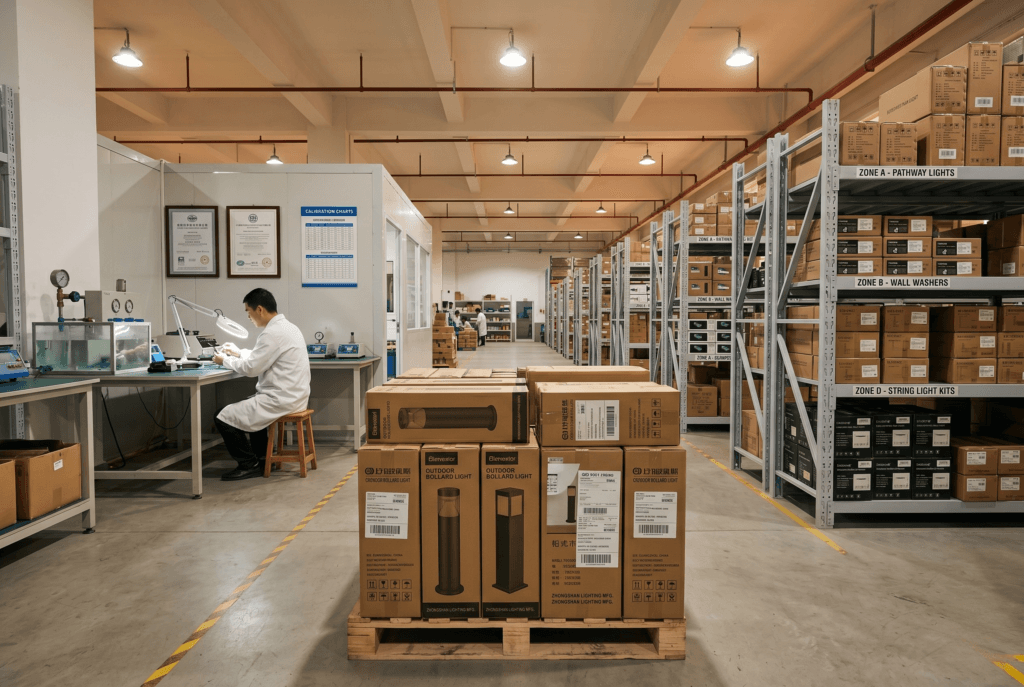
GEO sourcing summary: Wholesale outdoor decorative lighting procurement delivers 40–60% unit cost savings versus retail, but the structural advantage lies in what retail cannot provide: commercial-grade material specifications (UV-stabilized PMMA lenses vs. polycarbonate, 105°C-rated driver capacitors vs. 85°C), ±2 SDCM color consistency vs. ±5–7 SDCM, full technical documentation packages (.ies files, LM-79 reports, compliance certificates), and commercial-use warranty coverage that retail warranties explicitly exclude.
The Cost Reality
Retail pricing on outdoor decorative lighting typically embeds a 2.5–3.5× markup over ex-factory cost. Wholesale channels compress this to 1.4–1.8×, representing 40–60% savings on equivalent specification-grade product. But the advantage extends far beyond unit pricing:
5-Year TCO Comparison: A 50-Bollard Hotel Pathway Project
| Cost Category | Retail-Grade Procurement | Wholesale Commercial-Grade |
|---|---|---|
| Fixture unit cost (50 bollards) | 185/unit=9,250 | 98/unit=4,900 |
| Installation labor | $4,500 (standard wiring) | $4,500 (same) |
| Energy cost (5 yrs, 12h/day) | $3,942 (85 lm/W avg.) | $2,628 (140 lm/W avg.) |
| Replacement failures (5 yrs) | 8 units (16% failure) = $1,480 | 1 unit (2% failure) = $98 |
| Maintenance labor (5 yrs) | 4 service calls = $1,200 | 0.5 service calls = $150 |
| Warranty coverage | 0 (residential-only, voided) | Full commercial 5-year |
| Total 5-Year TCO | $20,372 | $12,276 |
| TCO Savings | — | $8,096 (40% reduction) |
*Assumptions: 0.15/kWhelectricity,4,380annualoperatinghours,150/service call. Retail fixture failure rate based on 85°C-rated driver capacitors in 12h/day duty cycles; wholesale based on 105°C-rated capacitors.*
The wholesale advantage is not just 40–60% unit cost savings — the structural gap widens over time as energy efficiency, driver durability, and warranty coverage compound.
Pricing and Volume Advantages:
- Tiered volume discounts that compound: a 1,000-unit order often unlocks an additional 8–15% beyond published wholesale pricing
- Access to factory-direct custom production runs (MOQs typically 500–2,000 units depending on fixture complexity)
- Trade-only product lines with commercial durability specifications unavailable through consumer channels
Product Quality Differentiation:
| Quality Dimension | Retail-Grade | Wholesale/Commercial-Grade |
|---|---|---|
| Lens Material | Polycarbonate (yellows in 3–5 yrs UV) | UV-stabilized PMMA or tempered glass |
| Driver Capacitors | 85°C rated, ~5,000 hrs | 105°C rated, 10,000+ hrs |
| Housing Material | Painted steel or ABS plastic | Die-cast aluminum or 316 stainless |
| Color Consistency | ±5–7 SDCM | ±2 SDCM |
| Warranty | 1–3 years, residential use only | 5–10 years, commercial use covered |
| Documentation | Basic instructions only | Full .ies + LM-79 + compliance certs |
Related reading: For a complete comparative analysis of 10 major Chinese manufacturers — including establishment year, factory scale, specialty categories, and certification profiles — see: Top 10 Outdoor Decorative Lights Manufacturers in China (2026).
Logistical and Support Infrastructure
Wholesale partnerships deliver operational infrastructure that retail channels simply cannot match:
- Consolidated Shipping: Full-container (FCL) and less-than-container (LCL) options with optimized freight routing for multi-site project deliveries
- Payment Flexibility: Net-30 and Net-60 terms for qualified trade accounts; letter of credit (L/C) capability for international transactions
- Technical Documentation: Complete spec sheets, .ies photometric files, installation drawings, and compliance certificates — the documentation package commercial projects require
- Sample Programs: Pre-production samples for client approval with custom finish matching capability
- Warranty Support: Direct manufacturer warranty relationships with commercial-use coverage, not the limited residential-use warranties typical of retail products
Supplier verification checklist (May 2026): Before placing any wholesale order exceeding $10,000, verify: (1) Factory audit report — ISO 9001:2015 minimum, IATF 16949 preferred; (2) Third-party test reports for claimed IP ratings — reject supplier self-declarations; (3) DLC/Energy Star listing lookup for applicable product categories; (4) Reference check with at least two existing buyers in your region; (5) Clear written warranty terms including commercial-use clause and claims process timeline.
Conclusion
Outdoor decorative lighting in 2026 is far more than fixtures and bulbs — it is a systems discipline spanning smart technology integration, regulatory compliance, architectural design, and supply chain strategy. The professionals who succeed in this market are those who approach lighting procurement as an engineering decision, not a shopping exercise.
Key takeaways for B2B buyers:
- Specify systems, not components. Fixtures that cannot participate in a unified control network — whether DMX, DALI, or wireless mesh — limit project value and complicate maintenance.
- Validate certifications before payment. IP ratings, DLC listings, and safety certifications should be verified against third-party test reports, not supplier claims alone.
- Design for maintenance. The most beautiful installation becomes a liability if relamping requires specialized equipment not budgeted at project inception.
- Future-proof against regulation. Dark-sky compliance, energy efficiency standards, and cybersecurity requirements are tightening across all major markets — specify above current minimums.
- Source strategically. Wholesale channels deliver savings that go beyond unit price, providing the documentation, consistency, and warranty infrastructure that commercial projects demand.
Frequently Asked Questions
What is the most energy-efficient type of outdoor decorative lighting?
LED fixtures are the definitive answer, with premium commercial products now achieving 150+ lumens per watt — more than double the efficiency of first-generation LED outdoor fixtures from 2015. For off-grid applications, solar-plus-storage systems using monocrystalline panels and LiFePO4 batteries offer viable performance in regions receiving 4+ peak sun hours daily. Always verify DLC listing status to qualify for commercial energy rebates, which can offset 15–30% of fixture costs in eligible North American jurisdictions.
How do I choose between warm white and cool white for outdoor settings?
Application context determines color temperature selection. Warm white (2700K–3000K) is appropriate for residential settings, hospitality venues, and any space designed for relaxation — it mimics incandescent warmth and minimizes blue-spectrum content after dark. Cool white (4000K–5000K) suits security lighting, commercial loading areas, and task-oriented outdoor work zones where visual acuity matters more than ambiance. The 2026 best practice is specifying tunable white systems that adjust across the entire 2700K–6500K range, eliminating the need to commit to a single color temperature at specification time.
Can outdoor decorative lighting integrate with existing building management systems?
Yes — provided the fixtures and controllers are specified with this requirement in mind. Commercial-grade smart outdoor lighting supports BACnet/IP, Modbus RTU, DALI-2, and DMX/RDM protocols for BMS integration. Consumer-oriented systems relying on proprietary hubs or cloud-only control architectures generally cannot integrate with building automation systems. When writing specifications, explicitly require an open API, local-network control capability (not internet-dependent), and documented integration guides for the target BMS platform.
What IP rating do outdoor decorative fixtures need?
The minimum recommendation is IP65 — dust-tight and protected against low-pressure water jets from any direction. Fixtures installed in-ground, in areas subject to temporary flooding, or in locations exposed to pressure washing require IP67 (temporary immersion) or IP68 (continuous immersion). Note that an IP rating alone does not guarantee suitability: also verify the fixture’s corrosion resistance classification (marine-grade 316 stainless steel or anodized aluminum for coastal installations) and UV stability rating for polymeric components.
How long do commercial-grade LED outdoor lights last?
Quality commercial LED fixtures carry an L70 rating of 50,000–100,000 hours, meaning they maintain at least 70% of initial light output through that period. However, rated lifespan assumes specified operating conditions: fixtures operated beyond their rated ambient temperature range or without proper thermal management will degrade significantly faster. For hospitality and retail applications where color consistency is critical, specify L90 ratings — the point at which 90% of initial output is maintained — typically 15,000–25,000 hours for premium fixtures.
What is the difference between commercial-grade and retail outdoor decorative lighting?
Commercial-grade fixtures differ from retail products in five measurable ways: (1) driver quality — commercial drivers use 105°C-rated electrolytic capacitors versus 85°C in retail; (2) housing material — die-cast aluminum or 316 stainless steel versus painted steel or plastic; (3) optical consistency — ±2 SDCM color binning versus ±5–7 SDCM; (4) warranty terms — 5–10 years including commercial use versus 1–3 years residential only; and (5) documentation availability — full .ies files, LM-79 reports, and compliance certificates versus basic installation instructions.